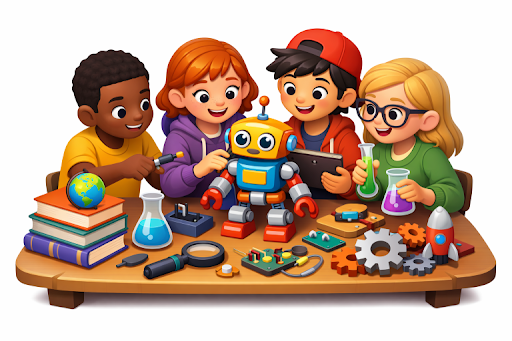
Hands-on STEM education is transforming student engagement by offering a dynamic alternative to traditional teaching methods. Instead of simply memorizing facts and formulas, students actively participate in building, experimenting, and solving problems, which ignites curiosity and deepens understanding. Programs at institutions like the top-rated charter school located in Sandy, Utah, are making STEM accessible, interactive, and meaningful for learners of all backgrounds. This educational shift is especially vital as the job market increasingly values candidates with strong problem-solving and analytical skills. By incorporating hands-on STEM experiences, educators equip students not only to grasp complex concepts but also to apply them confidently in new situations. As a result, students move beyond rote learning and are encouraged to innovate, collaborate, and think critically about the world around them.
Educators, parents, and policymakers alike recognize that STEM literacy is critical for both academic and future career success. As interest in STEM fields grows, the importance of inclusive and equitable access to hands-on opportunities only becomes clearer. Effective hands-on approaches benefit all students, but they can be especially impactful for children from underrepresented or economically disadvantaged communities, who might otherwise miss out on engaging STEM experiences. This focus on inclusivity makes hands-on learning a key strategy for addressing educational disparities nationwide. Real-world problem solving lies at the heart of effective STEM teaching. Learning experiences rooted in practical challenges help students see direct connections between classroom knowledge and everyday life. Whether tinkering with robotics kits or designing prototypes in a makerspace, students are actively preparing for future roles in science, technology, engineering, and mathematics sectors.
Benefits of Hands-On STEM Learning
Active participation in STEM subjects makes learning memorable and meaningful. Evidence suggests that hands-on learning environments improve comprehension and long-term retention, as students are not just passive recipients of information. Engagement in activities such as building models, conducting experiments, or using interactive technologies allows students to visualize and internalize abstract concepts. This approach fosters an environment where collaboration, inquiry, and exploration thrive, helping students develop confidence in their own abilities. Institutions that prioritize active STEM education often observe increased student motivation and persistence in these subjects. Research reported by Edutopia indicates that students who engage in hands-on activities tend to develop a more positive attitude toward science and math, which, in turn, supports their academic achievement and future interest in STEM careers.
Bridging the Gap Between Theory and Practice
Classroom lectures often introduce new theories, but genuine understanding develops when learners apply this knowledge through practical experiences. Hands-on STEM learning transforms abstract principles into tangible outcomes, such as when students use software to simulate natural phenomena or perform experiments that mirror scientific discovery. Tools like classroom probes, coding platforms, and physical science kits mimic real-world processes, showing students the relevance of their learning and preparing them for advanced study or careers in STEM fields. By mirroring the work of scientists and engineers, students gain insights into the realities of STEM professions. Integrating theory with experimentation not only solidifies learning but also sparks innovation and creativity, skills critical to solving today’s complex challenges.
Addressing Educational Disparities
Equitable access to STEM education remains a significant challenge in many communities. Hands-on learning has the potential to close achievement gaps and foster inclusivity. Accessible activities break down language or cultural barriers, allowing all students to engage with material regardless of background. “Thinking with your hands” strategies can be especially valuable for learners who struggle with traditional educational models, thereby creating more pathways for engagement and success. This approach democratizes STEM fields, providing opportunities for underrepresented and disadvantaged students to thrive and pursue advanced study or careers in these areas.
Real-World Examples of Hands-On STEM Initiatives
Across the country, innovative STEM programs are inspiring young learners. In Anne Arundel County, for instance, the Cal Ripken, Sr. Foundation collaborated with the University of Maryland Medical System to introduce hands-on STEM curricula and a community learning center designed to empower future innovators. Such initiatives, which combine mentorship with real-world problem-solving, are integral to fostering sustained interest in science and technology careers. After-school robotics clubs, summer coding camps, and maker fairs are additional initiatives that introduce diverse groups of students to hands-on STEM in supportive and engaging environments.
Implementing Hands-On STEM in Education
To maximize the benefits of hands-on STEM learning, educators can take practical steps:
- Weave project-based learning into academic curricula, encouraging students to work collaboratively on open-ended challenges.
- Make use of digital tools and interactive platforms to facilitate virtual or augmented STEM experiences when physical resources are limited.
- Build partnerships with local organizations and businesses to provide students with real-world exposure and mentorship opportunities.
- Promote a classroom culture where experimentation and problem-solving are celebrated, and mistakes are valued as vital steps in the learning process.
Through deliberate planning and a commitment to inclusive teaching practices, schools can ensure all students have access to high-quality hands-on STEM experiences that empower them to pursue further study and careers in these critical fields.
Conclusion
Hands-on STEM learning is reshaping education by bridging the gap between theory and practice, increasing inclusivity, and empowering students to become confident problem-solvers. By embracing active, practical, and collaborative learning, educators lay the groundwork for every student to succeed in a world increasingly shaped by science, technology, engineering, and mathematics.